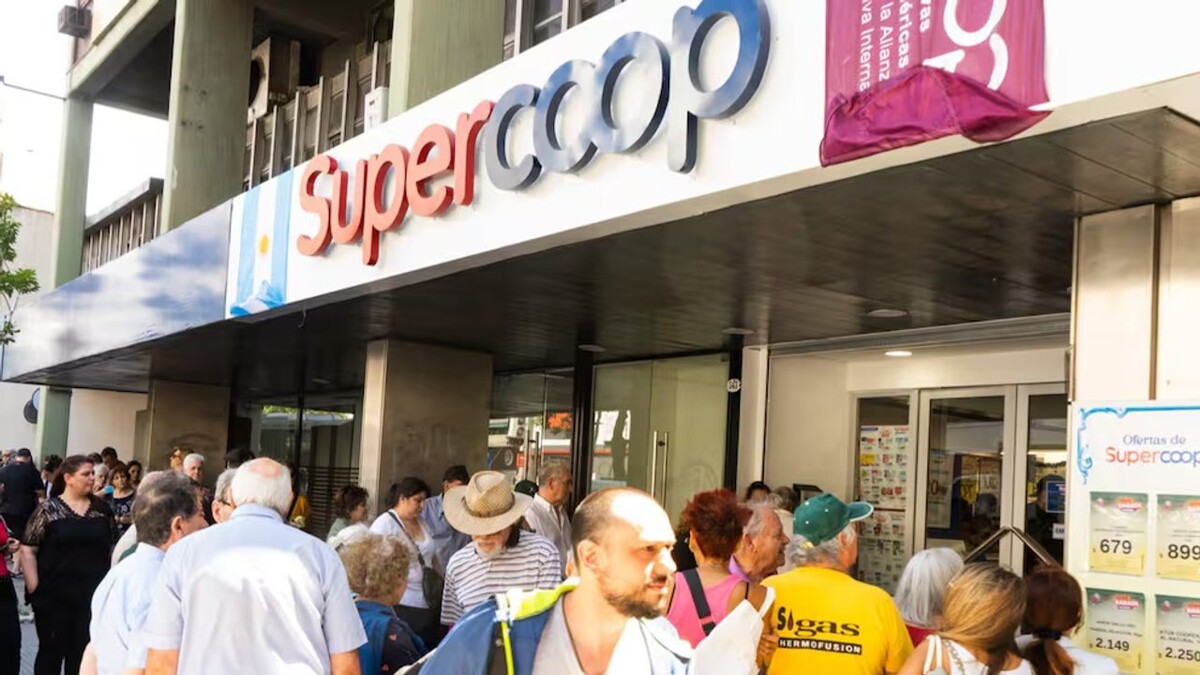
The historic Supercoop chain is back in the news: it has opened two stores in prominent locations in Buenos Aires after 30 years. Traditionally linked to El Hogar Obrero, it seeks to position itself in the neighborhood convenience store segment to compete for daily purchases. The properties belong to El Hogar Obrero, but management is handled by the Cooperativa Obrera de Bahía Blanca, which has a network of 152 stores and a presence in 75 cities. So far, it has already opened its first two sales points. The first one was in San Telmo, on Independencia, in December 2024. The second one arrived a year later, in Caballito, on Avenida La Plata. The next ones will be in Balvanera, on Perón at 2000, scheduled for June, and in Saavedra, on Manzanares at 3900. In all cases, these are premises that the chain itself had occupied until the late 1980s, when it was forced to close amid a financial crisis that led to a preventive proceeding that lasted for over 20 years. In this new phase, Supercoop is betting on a format aimed at daily shopping: 300 m² stores. "They are small stores, what we call a daily self-service," explained Pablo Barbieri, Deputy General Manager of the Cooperativa Obrera, to El Cronista Comercial. The great advantage is that it does not pay the 'premium' rent in several prime locations because it relies on the historic properties of El Hogar Obrero. "For now, these are just the four stores we are going to open. In the case of the next store in Balvanera, he advanced, a more significant improvement work is planned, which pushes the number higher." "Each store needs around 20 to 25 jobs; some may reach 30," he highlighted. "We measure it by recurrence: we see that they repeat a purchase once a week, which is logical for the size of the stores," explained Barbieri. Barbieri estimated that the expenditure for each inauguration varies depending on the necessary works. "It is very different from the one in the interior," detailed the executive. This adaptation is already beginning to be seen in the operation of the open stores: "We are happy with the response from consumers."